
The Field Is Hot: Competing Loyalties and the Strain on National Identity
Quantum Lens Field Report — October 28, 2025
Some bind loyalty to ideology a framework that makes chaos feel explainable.
From The Quantum Lens: Leading in an Era of Social, Political, and Organizational Entanglement
By Mark A. Williams — forthcoming February 2026
The Field Is Hot
The field is hot—not just politically, but perceptually.
We feel it in every meeting and headline, in the tightening of speech, in the low hum of vigilance under ordinary life.
The strain isn’t only institutional; it’s existential.
A nation’s shared story—its sense of self—is thinning under the weight of competing loyalties. We are still functioning, but the field trembles beneath the surface.
Each week brings a new wave of signals: shutdowns and furloughs that slow the machinery of service; legal reversals that confuse entire sectors overnight; executive orders stretching the borders of precedent; regional raids and courtroom battles that divide local from federal authority; conflicts abroad that tighten supply lines at home.
None of these events alone define the era. Together they create a saturation field—too many shocks, too little time to process. Meaning can’t keep pace with motion. This is the first symptom of perceptual collapse: information without integration.
The Perceptual Model in Motion
A nation can survive crisis; what it cannot metabolize is simultaneity.
When multiple shocks strike at once, the collective nervous system enters signal saturation—a condition where events outpace the capacity for meaning-making. The mind of a nation begins to scatter.
Across agencies, courts, and communities, this is what it feels like:
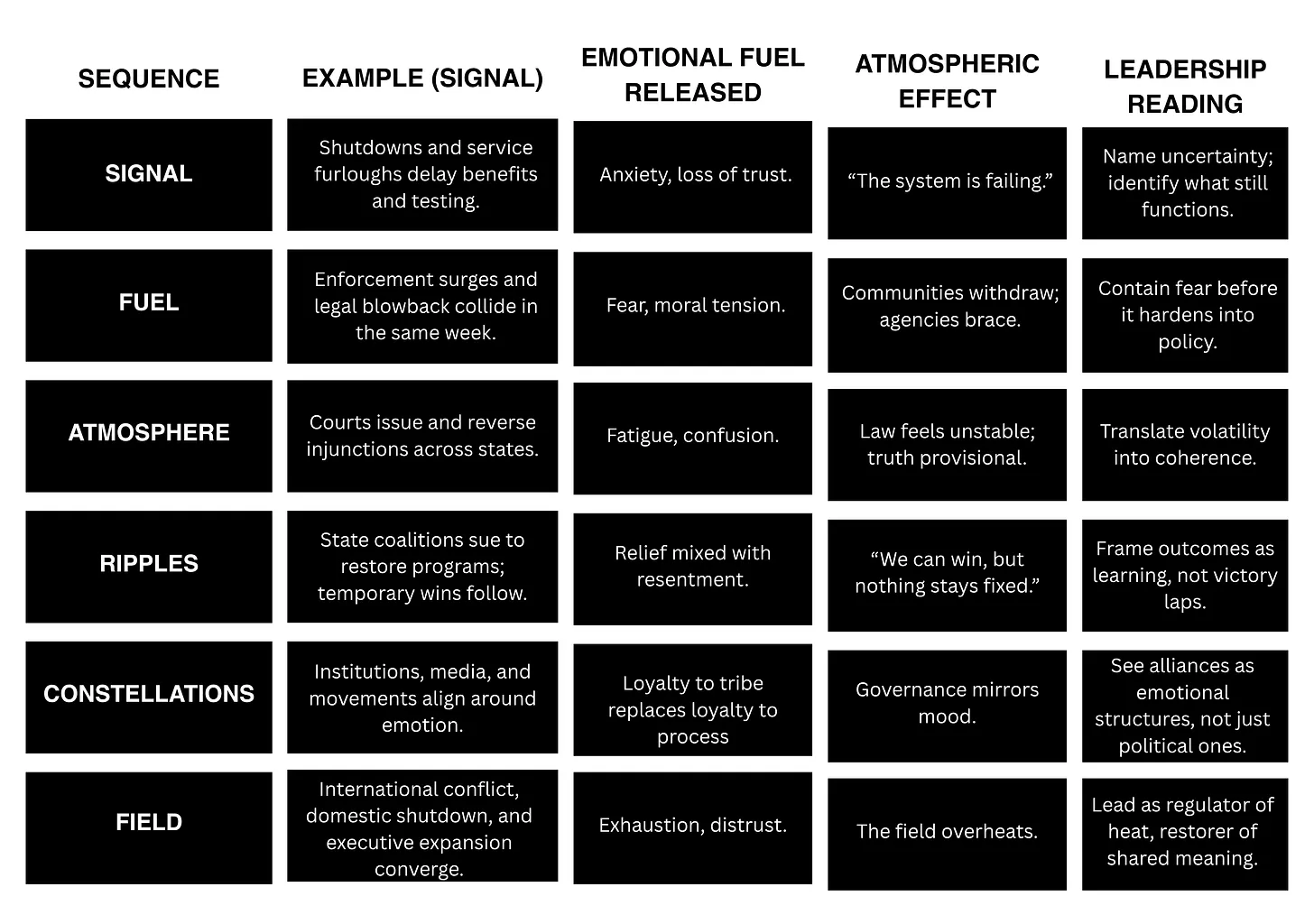
How to Use the Signal-to-Field Chart
Diagnose: Identify where you are in the sequence — signal, fuel, atmosphere, ripples, constellations, or field.
Interpret: Note the emotion driving each stage and how it’s shaping perception.
Intervene: Use the leadership reading to restore coherence before reaction hardens into policy.
Reflect: After events unfold, trace how the signal moved through the field to strengthen foresight.
When signals stack faster than systems can digest them, leaders lose time to think. Fear replaces foresight; outrage replaces orientation.
We mistake reaction for truth. But perception precedes policy. Whoever reads the energy first—leads it.
Meaning Lag and the Unitary Present
Another current moving through the field is the drive toward a unitary present—the concentration of executive authority in one decisive hand. For some, this feels like renewal: a return to order and efficiency in a tangled age.
For others, it feels like rupture: the betrayal of process, the shrinking of voice.
Inside institutions, that energy creates two emotional poles: fear of retribution, and exuberance of proximity to power. The first freezes moral imagination; the second clouds moral reasoning. Both are symptoms of compression—too much power, too little reflection.
At the citizen level, the same physics play out in miniature. When trust in systems collapses, people relocate their sense of safety to personalities. A segment of the field—what might be called the assimilationist current—
frames raw strength as salvation: he must have the power to save us from the others. To them, concentration is protection. The fear of loss merges with the hope of rescue. Loyalty becomes devotion; devotion becomes identity.
This is not a partisan phenomenon. It’s a pattern of perception that appears whenever institutions lose coherence. The emotional logic is ancient: when the village walls feel porous, the people look for a single gatekeeper.
Glubb’s Stages: The Arc of Identity
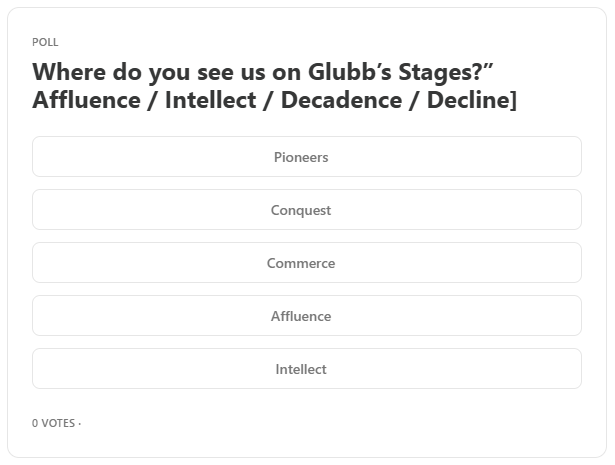
Every civilization has emotional seasons. Glubb mapped them—Pioneers, Conquest, Commerce, Affluence, Intellect, Decadence, Decline not as morality tales but as energy patterns. In the later stages, success erodes cohesion. Luxury outpaces gratitude; analysis replaces courage; words multiply faster than meaning.
The shared mythos weakens, and citizens begin to experience themselves not as a people, but as factions. America stands somewhere in that late arc between Affluence and Decadence, between fatigue and redefinition.
We still build, still innovate, still strive; but the emotional charge of unity has thinned. We no longer ask what are we building together? We ask which side are you on?
That question, repeated often enough, becomes the architecture of decline.
Loyalties in Competition and Collision
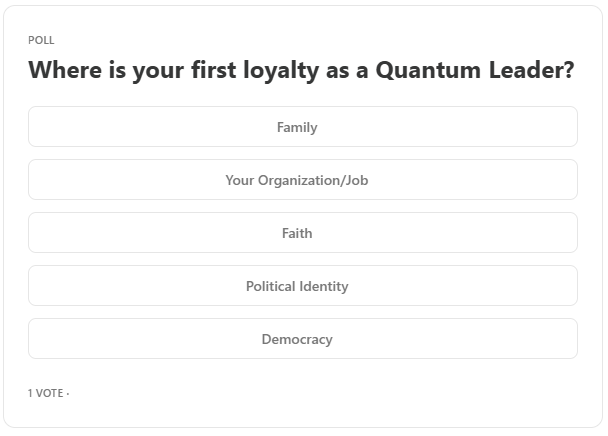
In a field this hot, loyalty becomes perception. We don’t merely hold opinions; we inhabit them. Some anchor loyalty in family and tradition—the local, the known, the familiar story.
Some bind loyalty to ideology a framework that makes chaos feel explainable.
Some tie loyalty to a leader, a figure who promises to restore the order they feel slipping away.
Others place loyalty in conscience, profession, or shared humanity—the slow work of dignity amid division.
Each form of loyalty has its virtue; each carries its shadow. Fear turns loyalty into defense; exuberance turns it into zeal.
This is competitive loyalty: the quiet contest for moral and emotional allegiance now shaping the national field.
And this is where Quantum Humanity begins the recognition that every person holds multiple loyalties inside the same psyche. They shift and recombine depending on threat, fatigue, or hope.
When fear spikes, loyalty to safety overrides loyalty to curiosity. When outrage surges, loyalty to justice eclipses loyalty to patience. When exhaustion sets in, loyalty to comfort overtakes loyalty to courage.
The work of the Quantum Leader is first internal: to sense which loyalty is driving perception before reacting to the world outside. Because every signal you send carries that loyalty’s frequency.
Five Zones of the October 28th Field
A diagnostic map for reading energy, perception, and coherence.
The field will remain hot. Cooling it is not weakness; it’s precision. Each Quantum Move below regulates heat—not by withdrawal, but by rhythm—helping leaders stay clear when systems burn.
Every field holds a temperature. As energy rises, inclusion narrows, passion hardens, and strategies move from reform to confrontation. Power condenses, and perception begins to distort. The work of a Quantum Leader is not to escape the heat but to regulate it, to keep awareness wide when systems begin to constrict.
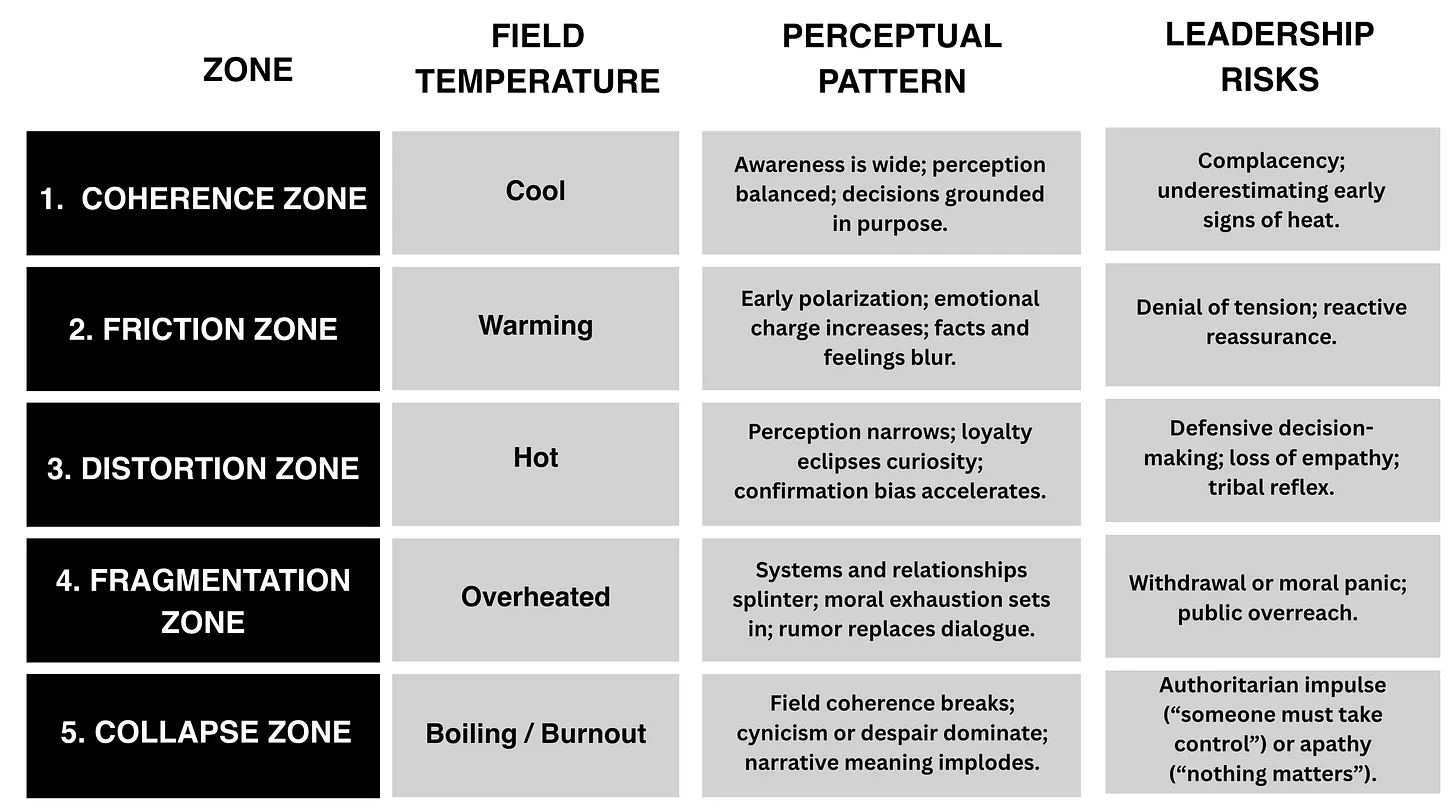
How to Use the Five Zone Chart
- Diagnose: Before any meeting, conversation, or decision, ask: Which zone are we in?
- Intervene: Apply the Quantum Field Practices that match the temperature — every practice is a cooling move.
- Recover: After high-heat events, debrief which zones were crossed and how quickly you returned.
The goal is not to eliminate heat. Heat is information. The work is to transmute it — turning reaction into rhythm, polarization into perception, exhaustion into coherence.
The field will stay hot. The goal is not escape but endurance— to stay coherent long enough for meaning to reform. Remember that the field is made of people: anxious, loyal, exhausted, hopeful. Every steady breath, every signal of dignity, cools a small portion of that shared atmosphere. Hold your frequency. Lead all of them.
Regulating Heat and Restoring Coherence
The field moves through us before we move through it. These practices translate the perceptual discipline of The Quantum Lens into daily leadership rhythm. They are not rules—they are stabilizers. Use them when the atmosphere feels charged, the signals conflict, or the meaning starts to thin. Each practice cools the field by bringing perception back into coherence.
The Inner Field — Where perception begins
- Read Your Inner Field First Before you read the room, read yourself. Notice what is tightening inside you—fear, fatigue, ambition, belonging. Ask: Which aspect of my quantum self is perceiving this moment? Leaders who skip this step confuse reaction for truth.
- Identify Cognitive Dissonance When your values and incentives diverge, tension becomes distortion. Don’t rush to fix it—name it. Awareness cools the field faster than justification ever will.
- Clarify Alignment Every decision begins with orientation. Ask: What value or purpose is actually steering this choice? Without alignment, you’re not leading—you’re orbiting pressure.
- Notice Emotional Fuel Every signal carries fuel—fear, pride, empathy, or despair. Identify yours before it burns through your integrity. Leaders running on fear exhaust everyone around them.
- Expand Perceptual Range Your nervous system narrows under stress.
Consciously widen your lens: step back, change context, ask others how the moment looks from where they stand. Range is resilience.
The Outer Field — Where perception becomes signal
- Read the Field, Not Just the Headlines Events are visible; atmosphere is not. Listen for tone, posture, and silence. They’ll tell you more about reality than the briefings ever will.
- Contain Before You Correct Fear and outrage spread faster than clarity. Acknowledge emotion before solving the problem. Containment creates the space where thinking can resume.
- Signal Humanity First People follow tone before content. Calm is data; empathy is structure. Signal care before competence.
- Restore Coherence, Not Control When systems overheat, the instinct is to tighten. Instead, clarify meaning.
Coherence cools faster than command. - Debrief the Field After the surge, pause. Ask what was lost, learned, or revealed. Every disruption contains intelligence if you have the patience to harvest it.
The inner field determines the quality of the outer signal. How you see shapes what others feel. When perception and purpose realign, leadership becomes less about managing chaos and more about regulating meaning.
Closing Reflection
A nation is not its systems or slogans. It is the invisible field of meaning we create together.
That field is now overheated—compressed by signal saturation, distorted by competitive loyalty.
But decline is not destiny. Perception is participation. Every leader who reads the field consciously can cool a fragment of it.
So pause before reacting. Breathe before broadcasting. Ask, What signal am I about to send? Which alignment is steering it? Does it widen coherence or tighten fear?
If enough of us ask those questions, shared meaning can thicken again. The field can steady. And the story of who we are can turn—from exhaustion toward renewal.
Read the field. Hold your frequency. Lead all of them.
Mark A. Williams
Author The Quantum Lens: Leading in an Era of Social, Political, and Organizational Entanglement
Forthcoming February 2026