
On December 4, 2025, the Trump administration released its National Security Strategy (NSS), and the reaction was immediate: analysts began feeling the weight of a renewed geopolitical narrative, emphasizing the significance of the civilizational framing. Recognizing this emotional response is crucial for understanding its influence on policy and perception.
To make sense of the moment, the history matters. The original Monroe Doctrine, announced in 1823, declared the Americas off-limits to European powers, a defensive shield that gradually evolved into a justification for American primacy in the hemisphere. Across Latin America, the doctrine is remembered as an assertion of control; in the United States, it became a background assumption of foreign policy. It never disappeared. But it also never carried the kind of cultural weight that this new strategy now invokes.
This is why the 2025 strategy feels different. It is not the re-creation of a forgotten doctrine, nor is it a brand-new worldview. It is a reversion to an old geopolitical frame, layered with a new civilizational logic that emphasizes how national and cultural identities shape global influence and societal perceptions, directly impacting policy choices and diplomatic priorities.
That shift is subtle, but it matters. Foreign-policy doctrines usually operate at the level of interests, threats, and alliances. This one operates at the level of identity. It signals who belongs within the imagined community America intends to lead, which nations are considered coherent partners, and which actors, from China to Russia to non-Western regions, are implicitly assigned to the outer rings of the geopolitical hierarchy. Nothing on the world map has moved. But the meaning of the map has.
You could feel the field adjust the moment the document appeared. In Latin America, the language awakened historical lived experiences, making the audience recognize the emotional weight of history; in Moscow, strategists saw cultural fractures as opportunities, highlighting the significance of societal perceptions; in Beijing, the doctrine’s civilizational framing triggered a different kind of calculation, centered on narrative, underscoring the importance of collective understanding; inside the United States, the document carried a quiet domestic message: the story America tells about the hemisphere is inseparable from who belongs inside the nation itself, fostering a sense of shared identity and belonging. Recognizing these varied responses can help anticipate how international actors might recalibrate their strategies in alignment with the civilizational framing.
For leaders in business, government, and global organizations, understanding how perceptions shape markets and partnerships is vital. Recognizing the emotional undercurrents will help them anticipate reactions and adapt strategies effectively.
To understand what this signal sets in motion, we read it through the Quantum Lens sequence:
Signal → Lens → Emotional Fuel → Emotional Atmosphere → Ripple → Constellations → Field
The signal has been released. The field has already begun to reorganize. What follows is how we decode the movement.
LENS — HOW THE DOCTRINE SPLIT THE STORY THE MOMENT IT LANDED
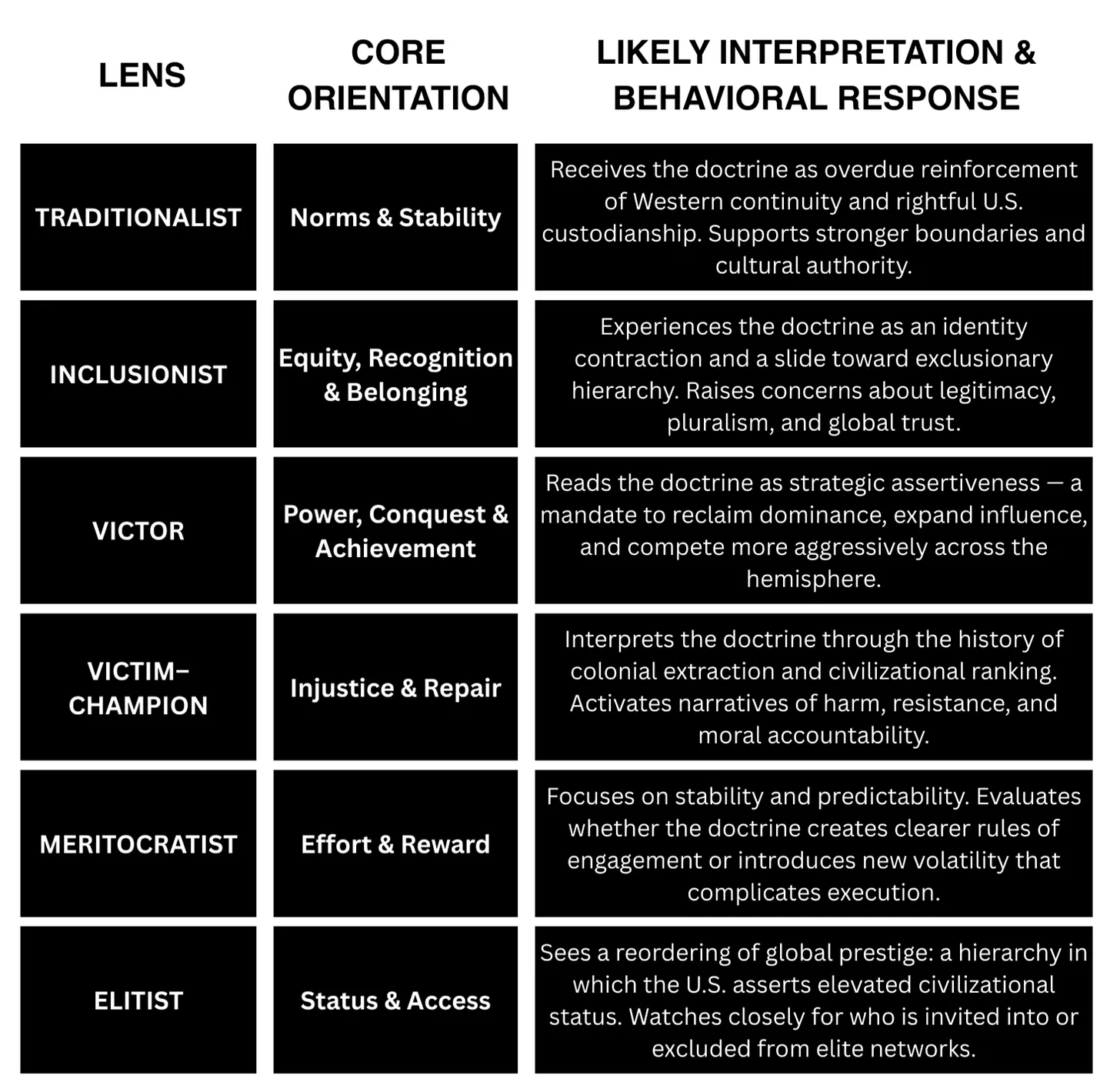
A signal never enters a neutral space. It lands in a landscape of worldviews, which I describe in my book, The Quantum Lens. There are six core lenses. They are deep narrative engines that shape how divergent stakeholders understand events, assign legitimacy, and decide what must be protected.
The administration’s National Security Strategy activated all six interpretive lenses within hours, fracturing the perceptual map because stakeholders are not reading the same story. The speed of that divergence shows how quickly perceptual shifts can reorganize the field.
LENS INTERPRETATION GRID
What this means and why it matters
These interpretations do not sit politely beside one another. They collide. The doctrine splits the perceptual field into competing realities:
- One worldview sees restoration.
- Another sees regression.
- Another sees opportunity.
- Another sees historical repetition.
This is why the atmosphere began shifting before any policy changed. When lenses diverge this sharply, emotional fuel concentrates quickly, and leaders must read the pressure before it becomes visible. Signals don’t create a single reaction; they split perception, activate different fuels, and merge into a single entangled field that can become combustible if not navigated early.
Signal → Divergent Lenses → Distinct Fuels → Colliding Atmospheres → Combustible Field
EMOTIONAL FUEL — WHAT THE NATIONAL SECURITY STRATEGY IGNITED
Every doctrine carries a technical meaning and an emotional one. The technical meaning sits on the page, the emotional meaning spreads through people, institutions, and alliances. What the Administration ignited was stored energy inside groups that have been waiting, fearing, or preparing for a shift of this kind.
Unlike the chart above, emotional fuel is not organized by lens. Fuel is organized by location in the system, the geopolitical and identity positions from which actors experience the doctrine. Here is how the fuel concentrates:
United States — Pro-Democracy / Post–WWII Order Fuel
These networks read the doctrine as a departure from the postwar system that prioritized alliances, rule of law, and shared governance. Their emotional response is not partisan; it is structural. The fuel is anxiety about democratic erosion, fear of civilizational ranking, and concern that the U.S. is abandoning the order it built.
This creates vigilance, scrutiny, and early mobilization.
United States — Nationalist / Traditionalist Fuel
For actors who believe Western identity has been diluted or threatened, the doctrine delivers emotional affirmation. The fuel here is restoration, relief, and the sense of a rightful hierarchy being reset. This produces confidence, assertiveness, and, at times, punitive energy toward internal opponents.
Latin America — Historical Memory Fuel
This is the most predictable and the most overlooked. For two centuries, the Monroe Doctrine has defined Latin America’s strategic vulnerability. The 2025 version resurrects that shadow. The emotional response is a mixture of resentment, pragmatic caution, dignity under pressure, and historical fatigue, the sense of being treated as a sphere rather than a set of sovereign nations.
If a U.S. leader does not understand this emotional memory, we will misread every subsequent diplomatic signal.
Russia — Opportunistic Fuel
Russia reads the reactivation of a civilizational hierarchy as validation of its own worldview. Its emotional energy is opportunistic confidence. A world split into civilizations is one in which Moscow can justify expansion, test boundaries, and insert itself as a counterweight to U.S. power. The doctrine does not intimidate Russia; it invites it.
Ukraine — Existential Fuel
For Ukraine, this doctrine is read through one lens: Will the U.S. still anchor a rules-based order, or is the world fully returning to spheres of influence? The emotional fuel is urgency and vulnerability, because if great powers are now dividing the world into civilizational blocks, Ukraine becomes a bargaining chip rather than a partner.
China — Strategic Calibration Fuel
China’s emotional energy is not reactive but calculative. It sees a U.S. returning to hemispheric dominance and wonders: Where will the U.S. draw its next boundary? How will this alter Belt and Road investments? How will allies reposition? The fuel is strategic curiosity mixed with long-term competitive focus.
Gen Z and Young Adults — Anti-Colonial / Systemic Justice Fuel
Gen Z does not separate foreign policy from identity. Their emotional fuel is outrage, solidarity, and ideological coherence: the doctrine becomes proof of a civilizational hierarchy that must be confronted. This fuel moves fast through campuses, creator networks, and global social platforms.
Corporate and Institutional Leaders — Stability Anxiety Fuel
Executives feel a different kind of activation: Will these complicate markets? Will supply chains be politicized? Will we be forced to signal alignment? The fuel is anticipatory stress, the kind that emerges when leaders sense geopolitical identity entering their workforce and customer base.
Why Emotional Fuel Matters
Fuel tells you where escalation will come from. Policies move slowly.
Fuel moves immediately. And once fuel begins to accumulate, the emotional atmosphere of the next stage in the chain takes shape. That atmosphere is the operating climate leaders must navigate in real time. Which means we now move to the atmosphere the frontier where emotional meaning becomes behavioral force.
EMOTIONAL ATMOSPHERE, WHAT IT FEELS LIKE INSIDE AND ADJACENT TO THE SIGNAL
When the administration released its 2025 National Security Strategy (NSS), there was a recalibration of which stories were suddenly allowed to surface and which identities felt newly exposed.
Among supporters, the atmosphere was one of elevation and purpose. Some felt recognition, as if something long-suppressed had finally been said out loud. Others felt a contraction, the sense that the country had stepped back into an older frame of hierarchy and civilizational sorting. Across institutions, you could feel the initial stages of a new alignment test: who is inside the implied circle, who is outside, and who now feels the pressure to prove their place.
It was a seriousness, a sense of stepping into a larger historical role, not just as citizens of a nation, but as guardians of a civilizational project. But that sense of elevation also carried vigilance: the watchfulness of those who believe a shared inheritance must now be protected.
Among those who feel outside the implied circle, the atmosphere cooled. Not fear, not yet, but a new brittleness. A sense of being assessed against criteria that were previously ambient: cultural fit, historical loyalty, proximity to an imagined center. Words like heritage, civilization, and stability became cues in a sorting process rather than neutral policy descriptors.
Among U.S. allies, especially in Europe, the atmosphere was something else entirely. Not fear, not surprise, but a kind of weary alertness, the sense of déjà vu that comes when American policy turns sharply inward yet demands outward influence. For some European governments, the NSS felt like a return to a familiar posture: Washington asserting custodial authority over a shared “civilization” while critiquing Europe’s own trajectory. The vibe was a mix of concern, annoyance, and resignation. Here we go again, with the added tension that this time the civilizational frame is far more explicit.
What exists now is not panic or clarity but charged ambiguity, the early stage of a reorganizing field.
Ripple #1 — Civilizational Logic Will Reorganize National Identity in Politics in Less Obvious Ways
The NSS does not create a new hierarchy. It reactivates an older civilizational ranking system that has appeared throughout American political history, one that quietly sorts groups by their perceived proximity to the “center” of Western civilization.
The shift is subtle but consequential. Rather than debating national and cultural identity directly, political and cultural actors will begin using terms such as “cultural integrity,” “heritage continuity,” “Western cohesion,” and “civilizational confidence.” These words sound neutral, even technocratic, but they do emotional work: they imply that some groups are guardians of civilization, while others are potential sources of disruption.
Because this hierarchy is familiar, not new, it will feel intuitively legitimate to some audiences and deeply alarming to others. As this framing spreads, institutions will face pressure to emphasize unity, tradition, and shared heritage over pluralism. The early signs of this shift will not show up in overt racial confrontation but in quieter, ambient debates about:
- curriculum,
- Hiring,
- public art,
- historical framing,
- And which stakeholders are portrayed as stabilizing or destabilizing forces?
Leaders who track the emotional field, not just the policy debate, will see this transformation earlier than those who wait for explicit conflict.
THE RIPPLE FIELD INSIDE THE U.S.
1. Civilizational framing will intensify domestic racial hierarchy
The NSS language about “civilizational standing” and cultural defense will be read as a cultural endorsement of hierarchy. Even without explicit racial language, the emotional architecture echoes long-standing narratives about who embodies “civilization” and who threatens it. This will sharpen tensions around immigration, DEI, multicultural education, and civic belonging.
2. A new wave of protest energy will form around anti-colonial themes
Because the NSS asserts U.S. primacy in the Western Hemisphere, activists will frame domestic resistance in terms of neo-colonial expansion and hemispheric domination. Protests will connect U.S. foreign policy to domestic policing, incarceration, deportation, and border enforcement. The emotional atmosphere will heat quickly because anti-colonial frames already sit close to the surface of U.S. racial politics.
3. Immigration will be interpreted through “civilizational sorting.”
Even without immediate policy changes, deportations, ICE actions, and asylum decisions will now be read through a tiered worldview. Immigrant communities will detect the shift instantly. Advocacy groups will interpret enforcement as part of a broader project of “protecting” Western identity by displacing non-Western populations. Fear, mistrust, and political mobilization will spread rapidly.
4. DEI and multicultural initiatives will experience a chilling effect
The NSS elevates civilizational cohesion over pluralism. Leaders will feel pressure to justify DEI in defensive terms or scale back its visibility. Employees will interpret this shift as the domestic expression of the same civilizational logic being applied globally. Psychological safety will decline; trust will fracture.
5. Social movements will intensify faster
Younger Americans who already understand politics through global lenses (colonialism, climate justice, migration) will read the NSS as a regression. Expect faster organization and activist projects, especially on campuses, where international students, diaspora identities, and racial politics intersect. New coalitions will form across Latino, Black, Indigenous, and Palestinian solidarity networks.
6. Law enforcement and local officials will feel pressure from both directions
School boards, city councils, and police departments will become the frontline of ideological collision. Public meetings will be charged. Leaders will face simultaneous demands to defend national identity and resist civilizational hierarchy.
7. Business will become an inadvertent battleground
Global companies will feel the shift immediately. Decisions about suppliers, partnerships, data centers, and facility locations will be evaluated through the lens of civilizational alignment. Talent will ask: What side is this company on? Reputational, operational, and workforce risks will rise.
8. The U.S. political field will reorganize around national and cultural identity
The NSS becomes the umbrella frame through which debates about immigration, education, trade, policing, and even foreign aid will be interpreted. The political field shifts decisively from issue-based conflict to identity-based conflict, the core domain in which the Quantum Lens is built to decode.
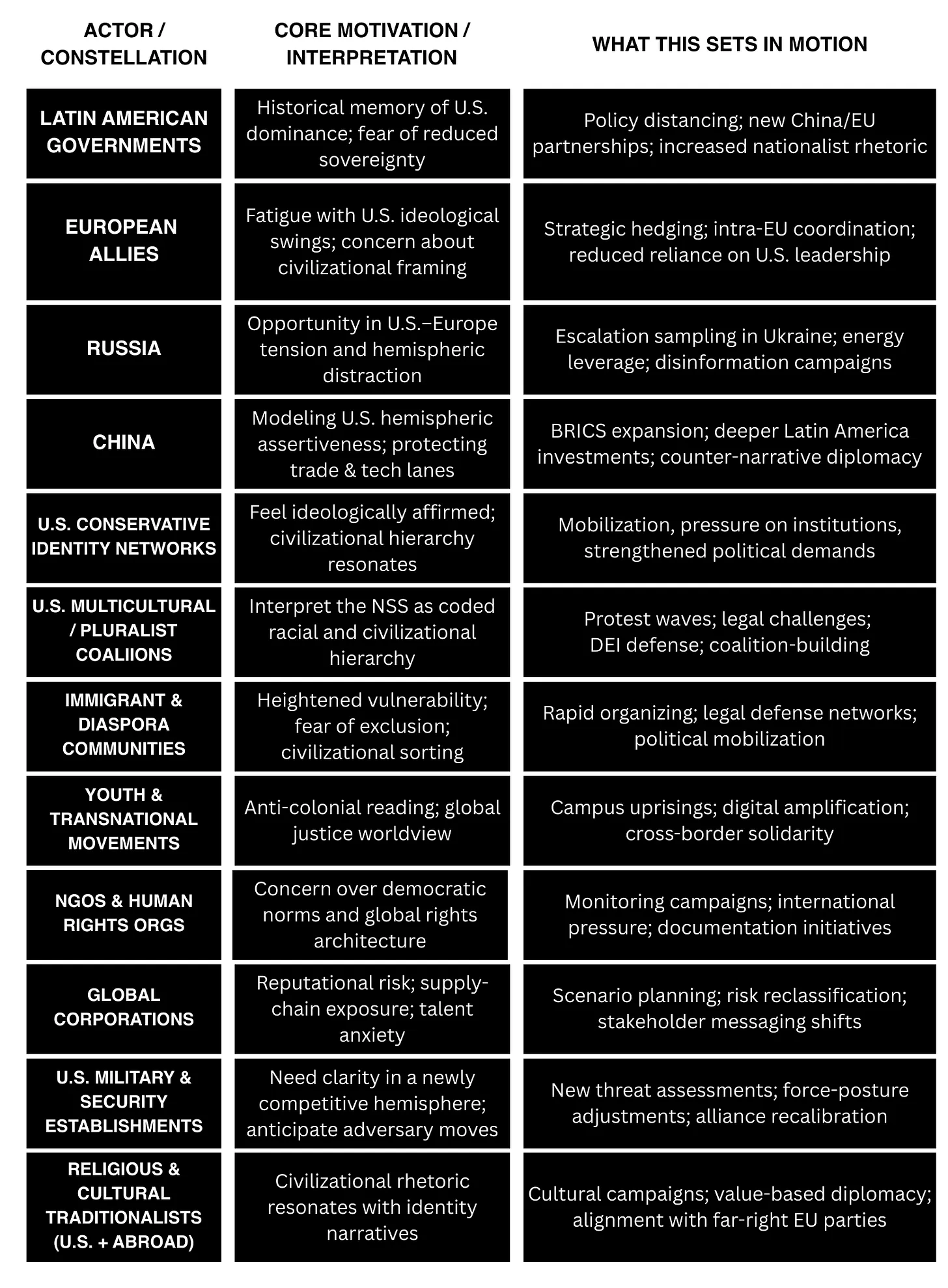
CONSTELLATIONS GRID — Who Is Now in Orbit
Leading in the 2026 Field
These shifts will surface first not as headlines but in daily organizational decisions, the places where national identity, authority, and pressure collide. Leaders must read these signals early, or they will be forced into a reactive posture.
1. Hiring & Talent Decisions: Watch for Atmospheric Sorting
People will read hiring choices as identity signals, not just workforce decisions.
Leaders should:
-
articulate criteria clearly and transparently,
-
Reduce ambiguity to prevent identity-based interpretation,
-
Prepare managers for heightened emotional reading of fairness, fit, and cultural alignment.
2. Curriculum & Training: Expect Pressure on Content
Internal training, leadership programs, and DEI content will be scrutinized through a civilizational frame. Leaders should:
-
Shift the focus to capability learning practical skills for a multi-reality workplace.
-
Protect space for plural perspectives while avoiding performative stance-taking.
3. Corporate Reputation: Prepare for Geopolitical Interpretation
Every brand decision will be read through global narratives of alignment or rejection.
Relocating a facility, choosing a partner, or suspending a program can be interpreted as:
-
pro-Western civilizational stance,
-
anti-immigrant positioning,
-
Or ideological resistance.
You must forecast meaning, not just outcomes.
4. Local Law-Enforcement & Community Relations: Expect Increased Tension
Cities, campuses, and municipalities will feel the first collisions.
Leaders should:
-
Train frontline staff to de-escalate identity-charged conflicts,
-
Anticipate protests tied to U.S. hemispheric actions or deportation surges,
-
Monitor local atmospheres for early agitation.
5. Supply Chains & Global Operations: Risk is Now Narrative
Geopolitical moves in Latin America will destabilize assumptions about:
-
regional partnerships,
-
resource extraction rights,
-
digital infrastructure plans,
-
And market access.
Companies must build contingency plans that include narrative risk, not just operational risk.
6. Migration, Diaspora, and Refugee Narratives: Expect Rapid Emotional Spread
Affected communities feel the policy atmosphere before they see outcomes.
Leaders should:
-
Build trusted channels of communication with immigrant, international, and diaspora employees,
-
Recognize that fear, vigilance, and status anxiety will influence retention and engagement,
-
Avoid dismissing emotional reactions as political — they are identity reactions.
7. Internal National and Cultural Identity Dynamics: People Will Reinterpret Their Place in the Story
Employees will read their status through cues of civilizational hierarchy. Leaders must:
-
stabilize belonging,
-
Signal fairness and predictability,
-
Acknowledge political realities but rise above political narratives.
THE BOTTOM LINE
The National Security Strategy is the missing piece that reveals the coherence of a much broader governing logic. The civilizational framing in the strategy connects directly to the administration’s current Venezuela posture, deportation strategy, and cultural directives surrounding DEI, race, and historical representation, including the quiet removal of memorialized figures from public view. This unified belief system about who belongs and who threatens the national project may provoke societal debates and international responses, which are crucial to consider in your role as a leader.
If this Quantum Lens Field Report opened new ways of seeing the terrain, I’d welcome a conversation. If you’re interested in a custom Quantum Lens Field Report and organizational debriefing tailored to your team’s real-world challenges, send me a note, and we can explore what that could look like.